01 — Context
A critical daily workflow running on spreadsheets
Every business day, Lowe's generated an Exception Price Report — a list of items where the system-recommended price was flagged as an outlier and needed human review. A Senior Pricing Analyst would pull the data, format it into an Excel spreadsheet, and distribute it to Pricing Managers across all divisions.
Each Pricing Manager was responsible for items within their division. For larger divisions — lumber being the primary example — the workload was divided further at the subdivision level. Multiple managers would work on the same spreadsheet simultaneously, leading to version conflicts, overwritten changes, and no record of who decided what and why.
The Senior Pricing Analyst spent most of their day managing this distribution and formatting process — time that could have been spent on actual analysis.
02 — Problem
Three compounding failures in the existing process
Problem 1: Simultaneous editing conflicts. Multiple Pricing Managers working on the same Excel file at the same time created constant data integrity issues. Changes were overwritten. There was no locking mechanism, no merge strategy, no single source of truth.
"Given the number of people involved, multiple Pricing Managers from the same division often worked on the same document at the same time."
Problem 2: No decision history. Pricing Managers had full autonomy to approve, reject, or revise prices without providing a justification. Because this work was routine, it was rarely documented. There was no historical record — no way to analyze why prices were set the way they were, no accountability, and no ability to learn from past decisions.
Problem 3: Wasted senior analyst time. The task of locating, formatting, and distributing the Exception Report spreadsheet fell to a Senior Pricing Analyst and consumed most of their day. This was pure overhead — a formatting and logistics problem masquerading as a business process.
03 — Process
Discovery-first, with four user roles in the room
The project started with a structured discovery phase. We interviewed four distinct user roles: Senior Pricing Analyst, Pricing Manager, Sr. Analyst Online Pricing Strategy & Execution (Pricing Execution), and Sr. Analyst Online Pricing Strategy & Execution (Pricing & Promotions).
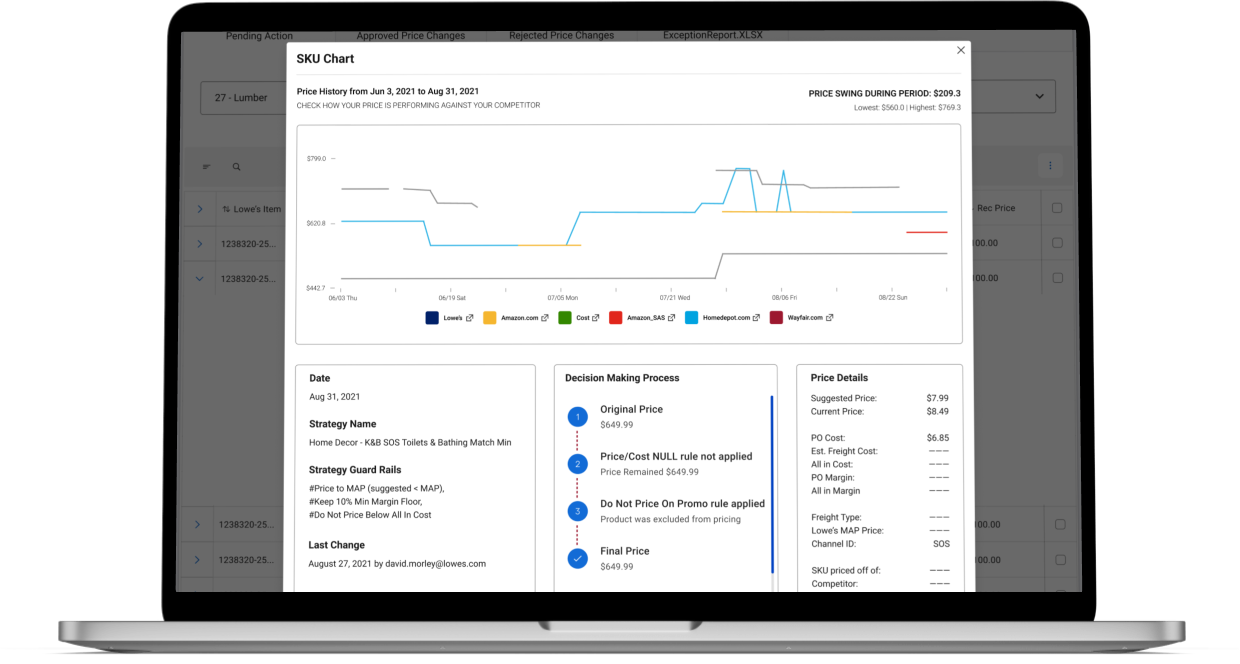
These interviews gave us a complete picture of the workflow from every angle — what each role did, where they lost time, what information they needed to make decisions, and what would make the process feel trustworthy. The Pricing Manager interviews in particular surfaced a key insight: managers needed to see competitive price data alongside their own data to make confident decisions. The Excel spreadsheet stripped this context out.
From the interviews we mapped a full workflow diagram, identified the three problem areas above, and set quantitative goals for the redesign: 90% reduction in task completion time, zero editing conflicts, and full decision history for every item.
Design iteration was rapid — we used Figma prototypes to test the core table interaction (approve/reject/set custom price) with Pricing Managers before building, validating that the new pattern was intuitive and faster than the existing spreadsheet workflow.
04 — Key decisions
Four design decisions that made the system work
Decision 01
Role-based access with division-level assignment
The application assigns each Pricing Manager to their specific division or subdivision — eliminating the need to manage a shared document. Each manager sees only their items. The Senior Pricing Analyst's role shifts from distribution logistics to oversight and exception handling.
Decision 02
Three-state table with automatic item routing
Items flow through three tables: Pending Action → Submitted Price Changes → Rejected Price Changes (or back). Actions are atomic — approving, rejecting, or custom-pricing an item moves it immediately to the correct table, with no manual sorting required. A "late" badge flags items submitted after the scheduled export window, so administrators can handle exceptions without trawling the full list.
Decision 03
Mandatory justification for non-standard decisions
When a manager sets a custom price (deviating from both the suggested and standard price), the system requires a justification before the item can be submitted. This creates the audit trail that was entirely absent in the spreadsheet workflow — and gives the business a data set to analyze pricing decision patterns over time.
Decision 04
Historical export for analysis and compliance
Every completed day's exception report is stored and available as a downloadable Excel file. This preserves the existing downstream workflows (other systems consuming the Excel output) while adding a full searchable history that the old process never had.
05 — Outcome
A 90% time reduction target — and a new workflow standard
The tool replaced the manual Excel process for the daily exception pricing workflow across Lowe's divisions. The 90% reduction in task completion time — from 30–45 minutes per manager plus a full day for the Senior Analyst to locate and distribute — was the primary success metric.
Beyond the time savings, the tool created structural improvements that the spreadsheet process was incapable of: no more simultaneous editing conflicts, a complete audit trail for every pricing decision, and a historical archive of all previous exception reports available on demand.
The mandatory justification field in particular changed the quality of decision-making — not just capturing decisions after the fact, but prompting managers to think deliberately before deviating from the suggested price.